New paper: morphological states and sediment transport in braided rivers
Our new paper, Morphological State Transitions and Sediment Transport Variability in Braided Rivers, has been published in Water Resources Research.
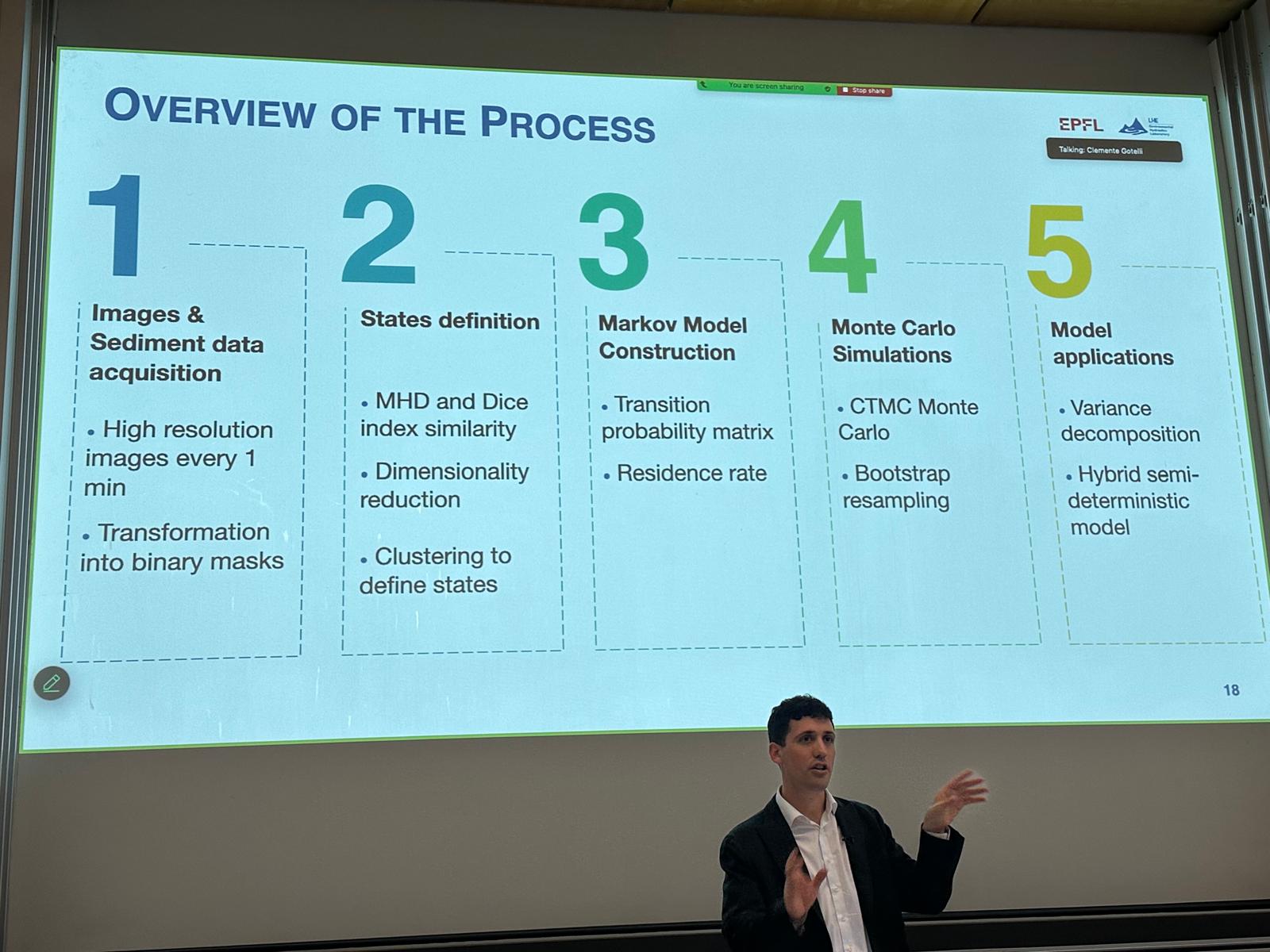
Braided rivers can move sediment in intense, seemingly unpredictable bursts even when water discharge and sediment supply remain constant. Using a long laboratory experiment, we show that this variability is organised by the river repeatedly switching among a finite set of channel shapes. Accounting for these morphological states improves the representation of how sediment transport changes over time.
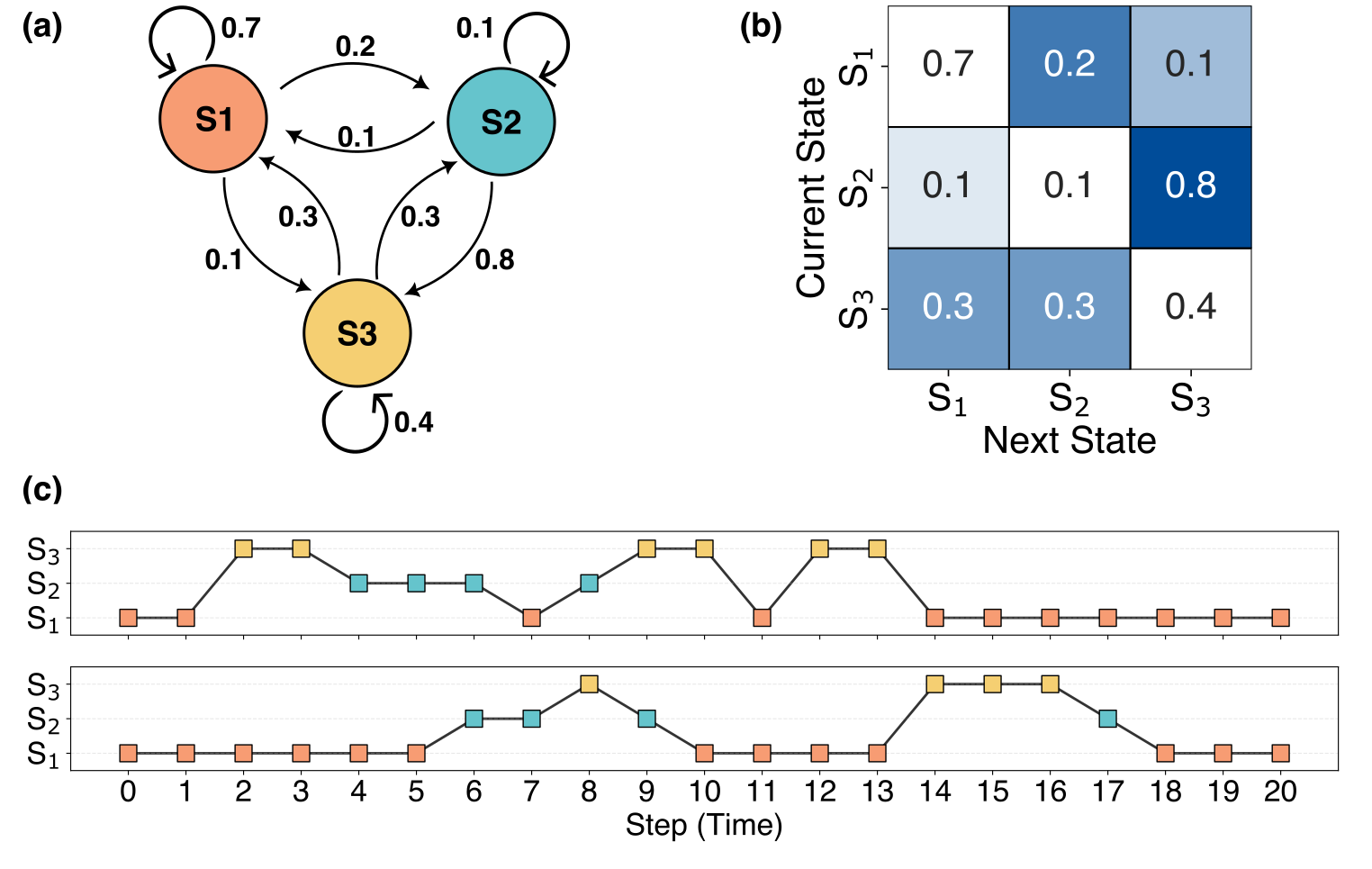
The figure below introduces the Markov-chain approach used to describe this switching: each state represents a recurring channel configuration, and the arrows and matrix express the chance that it persists or changes. The two lower sequences show different, but statistically consistent, histories generated from the same transition rules.
Figure 4. A simplified three-state Markov-chain example. The transition diagram and matrix define the possible changes between states; the lower panel shows two realizations generated from these probabilities. From Gotelli and Ancey (2026).
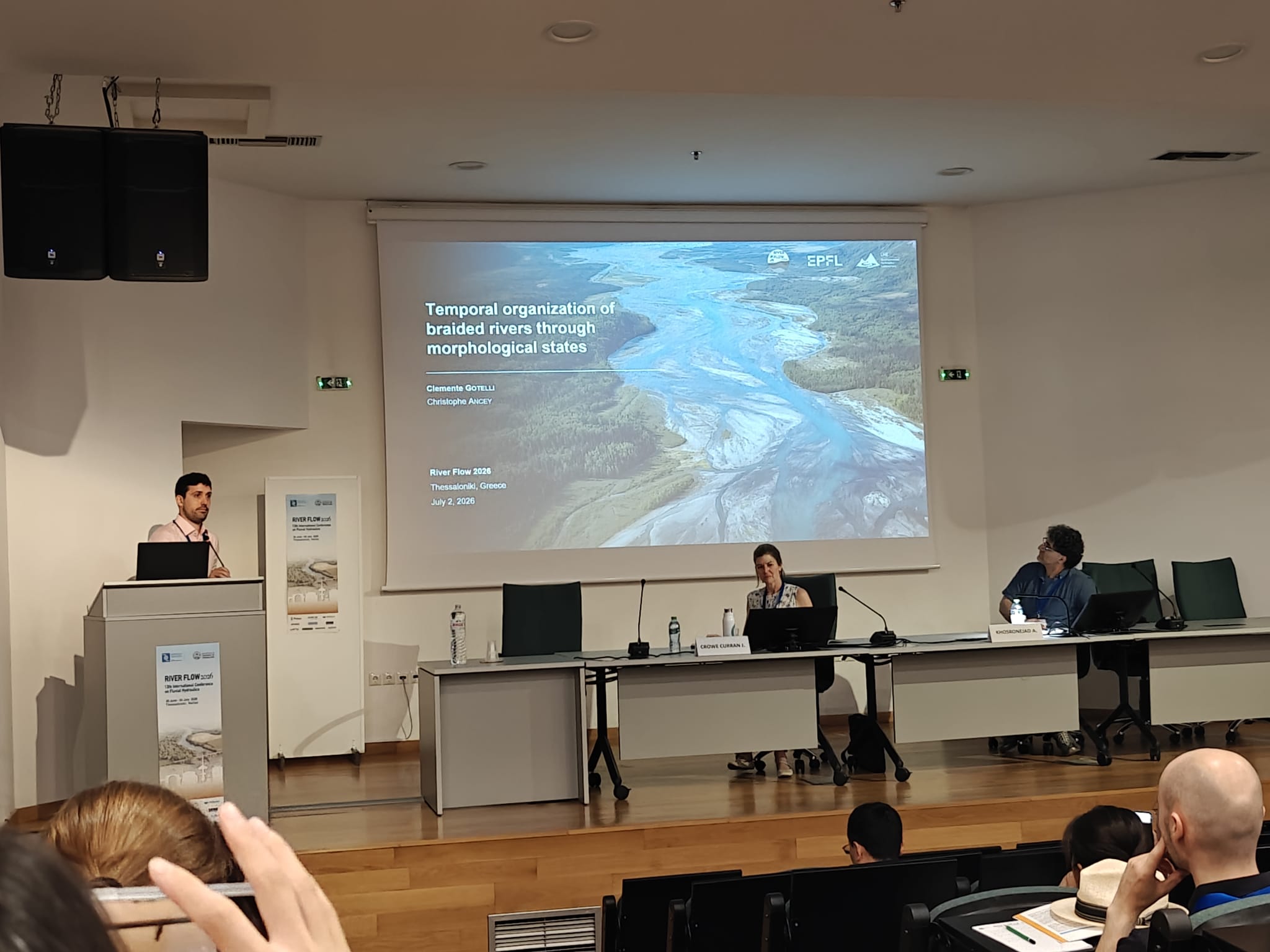
I had the pleasure of participating in River Flow 2026, where I presented my work, Temporal organization of braided rivers through morphological states.
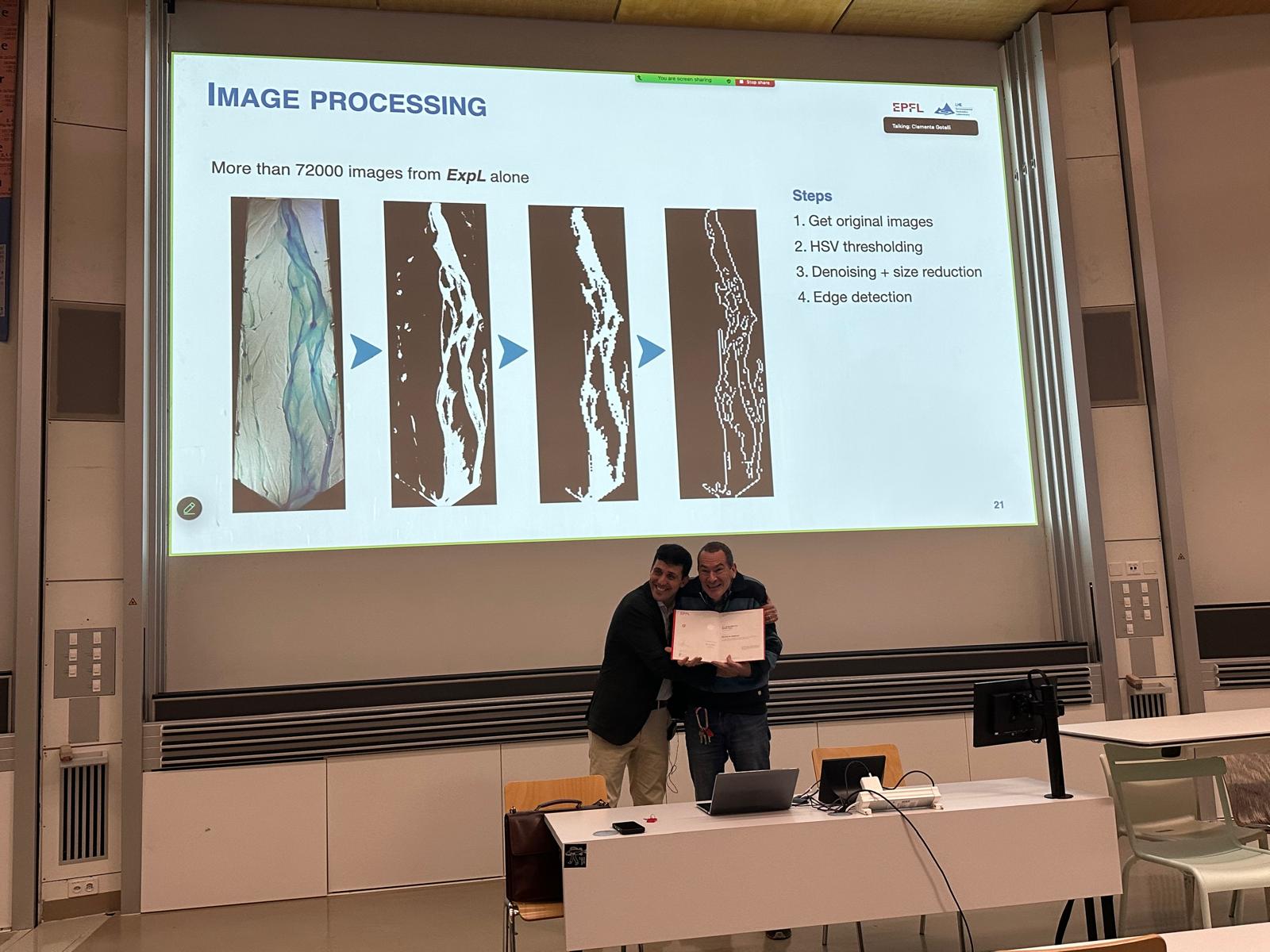
Following the private defense held last September, I am pleased to share that I have now successfully completed my PhD after the public defense. I extend my sincere thanks to my advisor, Professor Christophe Ancey, for his guidance and support throughout this work. The past five years at the LHE have been an exceptional research experience and a valuable period of personal growth. Thank you also to the Jury members: François Gallaire, Marco Redolfi, François Mettra, and Mirko Musa.
For a concise overview of my thesis, take a look at this post. You can also download the thesis here:
The STREEM lab aims to advance the technological development of water-based energy production, understand its co-evolution with a changing climate, and protect riverine ecosystems by combining laboratory experiments, data analysis, and analytical methods.
I will be running OpenFOAM-based numerical simulations to study how bedforms in natural rivers interact with hydrokinetic turbines, supporting designs that boost performance while safeguarding the river environment.